THE PLAYBOOK · 360-L
How to play Diagonal Sudoku
Make Diagonal Sudoku your next activity in the game library. Fill all cells with 1–9; do not repeat a symbol in any row, column or region. The two long diagonals must also contain each symbol once. Check the relevant rule before repeating a move. Identify the playing area and the controls you need. Keep the game area visible while you use its controls.
Make the controls familiar
Locate the buttons and input area before beginning a long round. Use the on-screen labels to avoid an accidental restart. Refer to the controls when needed.
Your goal
Fill all cells with 1–9; do not repeat a symbol in any row, column or region. The two long diagonals must also contain each symbol once. Read that aim before choosing your first action. Return to the instructions when a step is unclear.
Step by step
- Select an empty cell. The original clues cannot be edited.
- Choose a symbol from the number pad, or type it on a keyboard.
- Turn Notes on to record candidate symbols without committing an answer.
- Use Check entries to check your filled values. Hint reveals one value from the verified solution.
- Complete the board, or choose New puzzle for another board.
Controls
Tap or click a cell and use the number pad. Keyboard: arrows select cells; digits (and A–G on 16×16) enter values; Backspace erases. On a smaller screen, keep the active part of the board within view. A new-round button replaces the current round.
A useful example
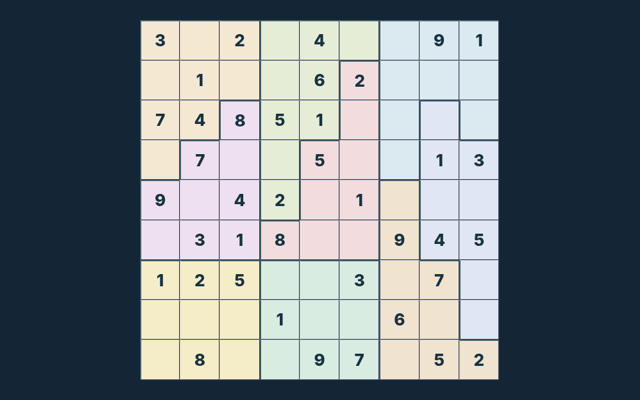
On one puzzle in this collection, row 1, column 5 has 3 in its solution. Read the clues on your current board before using that value; another puzzle can need a different entry. Your next round may have a different position, so inspect it before acting. Check the stated objective.
Watch out for this
Notes are reminders, not final entries. A full board only counts as complete when it satisfies every rule. Compare the situation with the worked example. Choose one rule to keep in mind for this round. Apply it consistently rather than guessing what another version might allow.
Common questions
While learning, what is the goal of Diagonal Sudoku?
Here is the relevant explanation: Fill all cells with 1–9; do not repeat a symbol in any row, column or region. The two long diagonals must also contain each symbol once.
For a quick reminder, how do I control Diagonal Sudoku?
Keep this in mind: Tap or click a cell and use the number pad. Keyboard: arrows select cells; digits (and A–G on 16×16) enter values; Backspace erases.
When I return, what example helps explain Diagonal Sudoku?
Keep this in mind: On one puzzle in this collection, row 1, column 1 has 5 in its solution. Read the clues on your current board before using that value; another puzzle can need a different entry.
While reading the Guide, what should I watch out for in Diagonal Sudoku?
The key detail is this: Notes are reminders, not final entries. A full board only counts as complete when it satisfies every rule.
As a new player, what format does Diagonal Sudoku offer?
Keep this in mind: Play using the solo mode shown on this page. Read the controls before starting a new round.
Before I begin, which play mode does Diagonal Sudoku use?
The mode on this page is Solo. Same-device play uses one screen; this game library does not provide internet matchmaking.